HOUSE CALLS
for the sick, by the sick.
 pencil drawing in purple, depicting a birds-eye view of a tile-floored bedroom, two listeners laying down in a bed, heads on opposite sides. at the foot of the bed, a musician sitting cross legged plays a keyboard and a laptop, with cords and wires extending from their setup to speakers, air purifier, bedside table.
 one on one, and intimate music + performance shared directly from one disabled person to another, either over the telephone or delivered to bedrooms or bedroom windows.
document version of this text
WHO IS THIS FOR ?
Music for people who have difficulty leaving their home and making it to live music events — for any who are ill, disabled, in grief, for any with low capacity, low mobility difficulty, whether chronically or temporarily, or etc etc. Is this you? Is this a friend?HOW DO I SIGN UP ?
Please fill out this short interest formThen, we will reach out – to provide more details, answer any questions, and to learn about your preferences and access needs.
The aim is to work together to make this an accessible experience for us all, from precautions to prevent viruses, to communication needs, to needs around volume, length, softness of sound. We will meet as many requests as we have capacity for.
HOW DOES IT WORK ?
We’re offering formats for you to pick from, depending on your capacity, interest, and comfort level :- Performance in your home or by your bedside (NYC)
- Musician serenades you from the street, through an open window (NYC)
- Song serenade over the phone
WHAT’S THE MUSIC ?
This August/Fall is our first “season” of this experiment – our musician is ANNA RG, who can offer songs (let us know if you have a song request!), and/or a performance of their ongoing piece :AIR CHANGE PER HOUR – this droney ambient piece uses an air purifier as the speaker, and is a layered collage of soft humming drones, and recordings submitted by disabled and sick musicians performing responding to prompts and scores Anna wrote, humming, singing, breathing, rustling, whistling. The performance can be adapted to vary in length, volume, and intensity, depending on the preference of the audience.
This work was first developed at Issue Project Room last spring; a disabled person wrote in the day of the show, unable to attend due to poor air quality that day. So Anna brought the show to their bedroom last summer – the very first House Call !
WHAT DOES IT COST ?
It’s free !WHAT ABOUT ACCESS ?
Once you make a request, we will — with you, or your caregiver or both — work through a short list of questions about any specific access needs you have that we can work with, to make the show accessible, easeful, and safe for both you and our musician!If you are wondering what kind of access needs you can advocate for, how we’ve been thinking about access – we have included a small list of potential access needs/accomodations for your musing. This is not a comprehensive list, we are always happy to chat about how to fulfill your access needs as the audience member.
3
WHAT’S THE SICK MUSIC CENTER?
- THE SICK MUSIC CENTER was founded by chronically ill musicians who missed live music. so, they invited a friend to play at their window. They then wondered, how more people stuck at home could receive such a serenade. It started with a radio play, imagining this!
- The Center, which launched at Recess Art , has hosted a study group for disabled and sick musicians, concerts, and workshops and is currently building an online Index of Sick Music.
- All of our musicians have lived experience with chronic illness, chronic pain, disability.
- This initiative gets its name ˆHOUSE CALLS” from one of our founder’s grandfathers, Fred, who was a disabled doctor who made house calls in his small town, and spoke about how he thought that being disabled himself made him a better doctor. This project is inspired by the idea of disabled people sharing sounds with each other.
- ABOUT ANNA (the musician) is an artist, composer, organizer and music teacher with long covid. She’s made records – her band’s album on Smithsonian Folkways was called “a radical expansion of what folk songs are supposed to do,” by The New Yorker. She toured internationally for a decade before she got sick, played Carnegie Hall, a Tiny Desk Concert, the Newport Folk Festival– and now, hopefully, your living room ! They are slowly creating an album of songs, and are the founder of the Sick Music Center.
- ABOUT LEO (our coordinator!)
I’M A MUSICIAN, I’D LOVE TO GET INVOLVED!
We’d love to hear from you ! Our dream is to find ways to support (and fund!) an expansion of this project, and have a roster of sick/disabled musicians joining this experiment.I HAVE MORE QUESTIONS!
Don’t hesitate to reach out : Sickcenters@gmail.comHOW DO YOU DEFINE SICK ? MUSIC?
These are our project’s working set of associations with the two words –SICK as in having illness, working with illness, as in being disabled in its infinite forms. Sick, as in living Mad, living deep in grief, in addiction, in pain. Sick as in diagnosed or without name, sick as self diagnosis. Sick, as in moving with, belonging to, communities and lineages of sick and disabled cultures. Sick as in sick of it or as in, if ‘society’ is ‘well,’ then I don’t want to be that.
MUSIC as in transmission of sound, of vibrations, as in connective, expressive tissue, as in joining or making traditions of rhythms and storytelling and ritual, and sonic waves touching our bodyminds. Listening, as in the directing, offering, wandering, misdirecting, flying, and finding of our bodily attentions, beyond ear-hearing
MORE ACCESS THINKING
document versionLet’s work together to make this experience accessible for all of us (heart emoji)
Here’s a starter list of access considerations we’ve been thinking about, from the perspective of your needs as audience, and ours as the musicians – We’ll have the chance to get into detail, after the initial interest form is filled out!
- Sound sensitivity
- Use of assistive listening devices, needs and/or requests surrounding working with this and live music
- Light sensitivity
- Scent sensitivity
- Airborne virus precautions needed
- other immune system related needs
- severe allergies
- mobility needs (like keeping pathways clear)
- request for image descriptions, sonic descriptions
- communication requests and needs, from font size for emails, request for voicememo rather than text, etc
- need interpreter (ASL, translator, any other type of interpretation)
- requests around length of visit, capacity needs
- request for check-ins (inspired by thinking about visiting a friend with mecfs, checking in with how their symptoms are responding to things!)
- anything else you can think of !! This is an incomplete list, and know there are access needs that might not be listed yet – we would love to accommodate your needs in any way we can :)
We the organizers & musicians are also disabled and live with chronic illness.
PREVIOUS VERSIONS
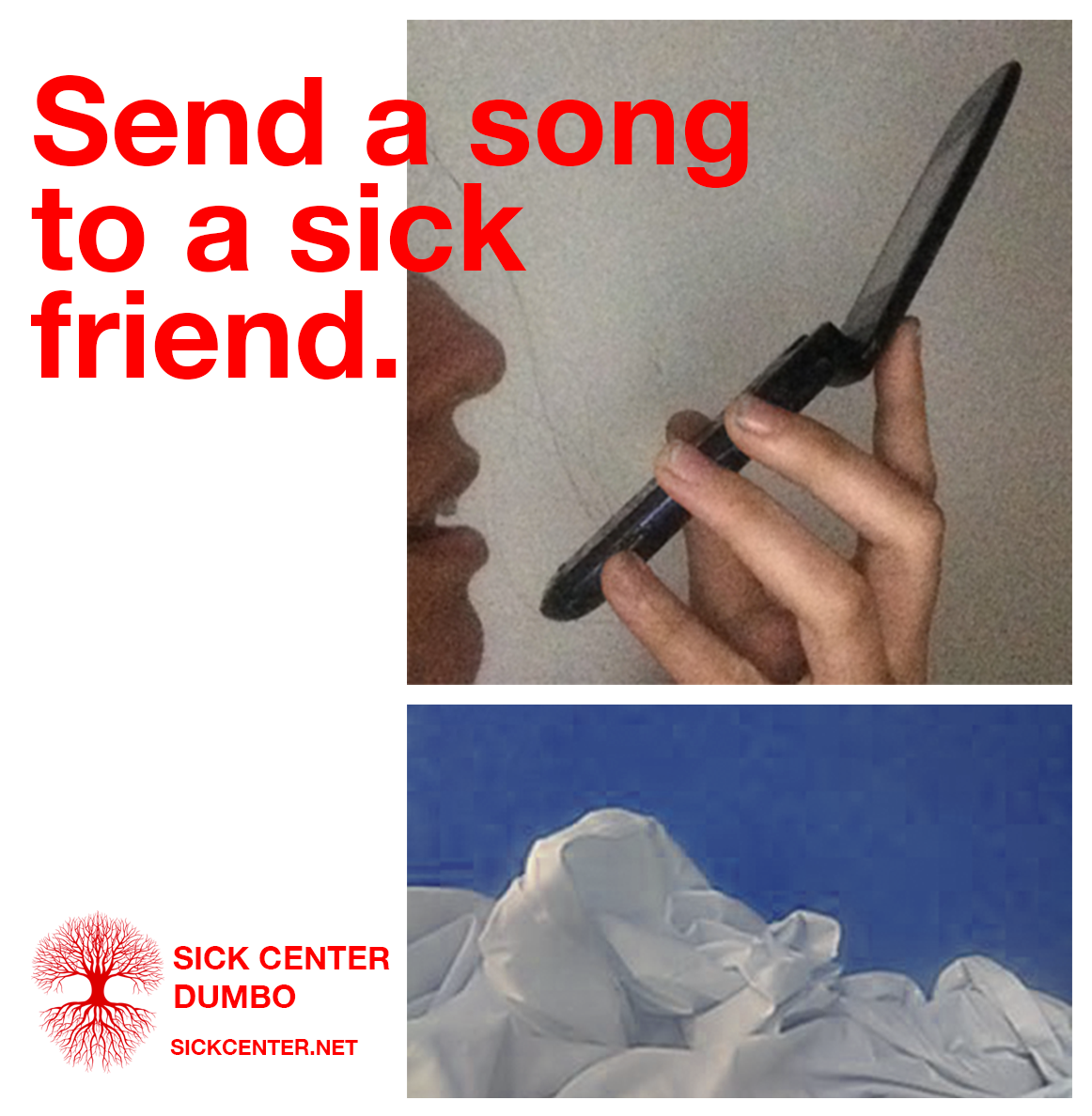
august 2023, stationed from a temporary office, supported by the Brooklyn Arts Council, during which 35 sick folks were sung to, over the phone & in person, one August afternoon.

[Anna, a white femme with brown hair in a bun, and red striped shirt, sits and talks on the phone, smiling. In the background, a makeshift cubicle with a red tree painted on the background, and it says SICK CENTER.]